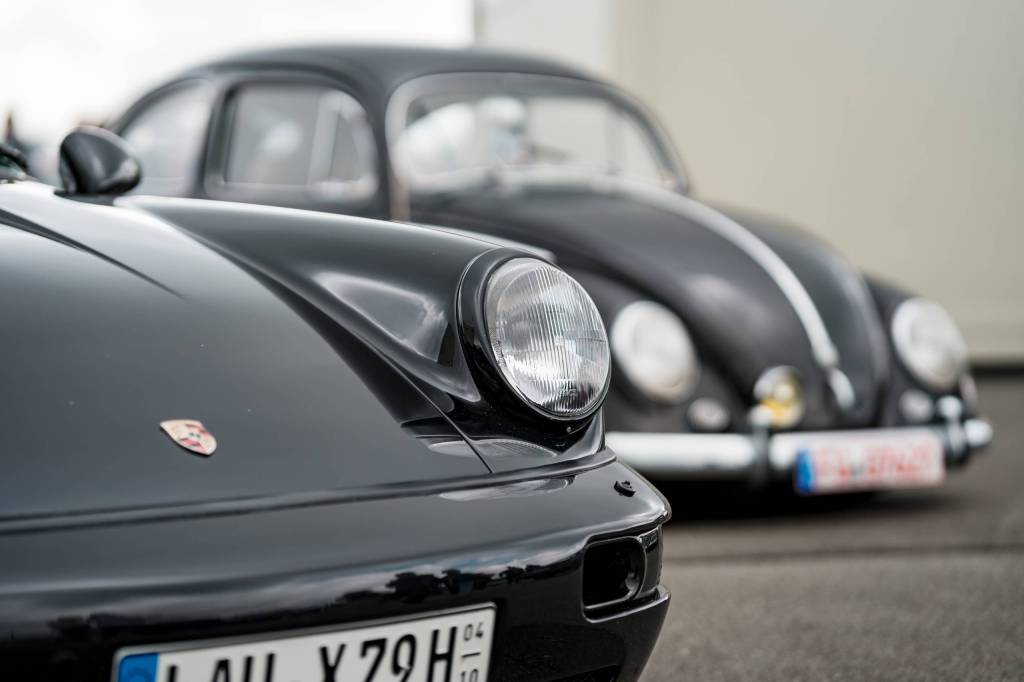
The Beetle became an icon because everybody could have one. The 911 became an icon because everybody could dream of one.
Why do we keep falling in love with the Porsche 911?
Is it the round headlights, the rear-mounted engine with its unmistakable grille? Is it the small, plucky design that resembles the toy cars of our childhood? Or is it simply an example of true automotive art?
The Porsche 911 is an icon in itself. Its entire body is recognizable from arguably every single angle — yes, even from above. Strip every 911 of its badge and nobody would wonder what car it was.
This might also be true for a handful of other iconic brands, like Mercedes-Benz or BMW, but most people would still struggle to pinpoint the exact model or series. With the 911, this simply doesn’t happen.
So, is there any other car that has ever occupied the same position? One model, with one simple name, recognizable from every angle?
Yes, there is. I must admit it.
One other car in the history of motoring has achieved something similar: the Volkswagen Beetle.
Round, jolly, practical, cool, cute and a little goofy. The car of cars. From Herbie to Pelle the Police Car in the Norwegian children’s series Pelle Politibil, the Beetle has become something much bigger than a machine for getting from A to B. It is a character.
And in terms of sheer numbers, the Beetle leaves the 911 in the dust. A total of more than 21.5 million original Type 1 Beetles were produced between 1938 and 2003, compared with around 1.2 million 911s since its introduction in 1963.
So, is the 911 really the greater icon?
Yes.
Let me explain why.
The Beetle had one of the longest production runs in automotive history and became one of the most successful cars ever made. It was designed to be a car for the people, and that is exactly what it became. Beach party, wedding, weekend trip, country-road cruising or a long journey across a continent — the Beetle somehow fits them all.
The 911, on the other hand, was never meant to fit every occasion.
And that is exactly why it does.
There is no subtlety to it. There is never any doubt about what has just driven past you. Yet somehow it is as offensive and inoffensive at the same time as a pair of dark blue jeans. A 911 can arrive outside a five-star hotel, a supermarket, a petrol station or a small house in the countryside and somehow look completely at home.
More importantly, the 911 doesn’t merely attract attention. It creates a peculiar kind of envy — an optimistic one.
It is the car you probably cannot afford, but one that isn’t ridiculous to dream about. It exists in that narrow space between fantasy and possibility. A Ferrari might remain a poster on the bedroom wall. A 911 makes you think: Maybe one day.
And it is this feeling that makes the 911 an icon not only for the few who own one, but for all of us who don’t.
We want it. We love it. It tickles the imagination and puts a smile on our faces. There is something strangely joyful about catching sight of a 911, whatever the circumstances. For a second, your eyes follow it. Time slows down. You become part of its story, even if only until it disappears around the next corner.
Which brings us to the big Beetle in the room.
There is no escaping the origins of the Volkswagen Beetle. The car was born out of Nazi Germany’s attempt to create a Volkswagen — literally a “people’s car” — and Ferdinand Porsche was central to its development. Its history is therefore inseparable from a much darker political project, however friendly and innocent the Beetle itself would later become in popular culture.
The connection between the two cars makes the comparison even more interesting.
Look at them side by side and the family resemblance is difficult to ignore. The rounded roofline. The circular headlights. The rear-mounted engine. The compact silhouette. The basic idea of a small, aerodynamic car with its mechanical heart behind the passengers.
The Beetle and the 911 are not merely two unrelated icons. They belong to the same strange branch of the automotive family tree.
But while the Beetle eventually became a symbol of another era, the 911 refused to grow old.
Can you spot the difference between a 991, a 996 and a 997? If you are an enthusiast — or simply enjoy paying attention to detail — you probably can. To everybody else, however, they are immediately and unmistakably Porsche 911s.
And perhaps that explains its success better than anything else.
For more than sixty years, Porsche has changed almost everything without changing the thing that matters. The 911 became faster, wider, safer, more luxurious and vastly more technologically advanced. Air cooling disappeared. Turbocharging spread across the range. Screens entered the cabin. And now, as the automotive world moves deeper into electrification, the 911 has entered the hybrid era.
Yet it is still a 911.
The silhouette remains. The round headlights remain. The engine remains behind you. Most importantly, the feeling remains.
The Beetle became an icon because everybody could have one.
The 911 became an icon because everybody could dream of one.
And more than sixty years later, we are still dreaming.


Leave a comment